Why I built it
It started as a tool for myself: I study Japanese (moving from N4 toward N3) and wanted a way to review that fit how I study. Along the way I saw room for a product aimed at Spanish speakers learning Japanese or Chinese, so I built it for others to use too.
How it works
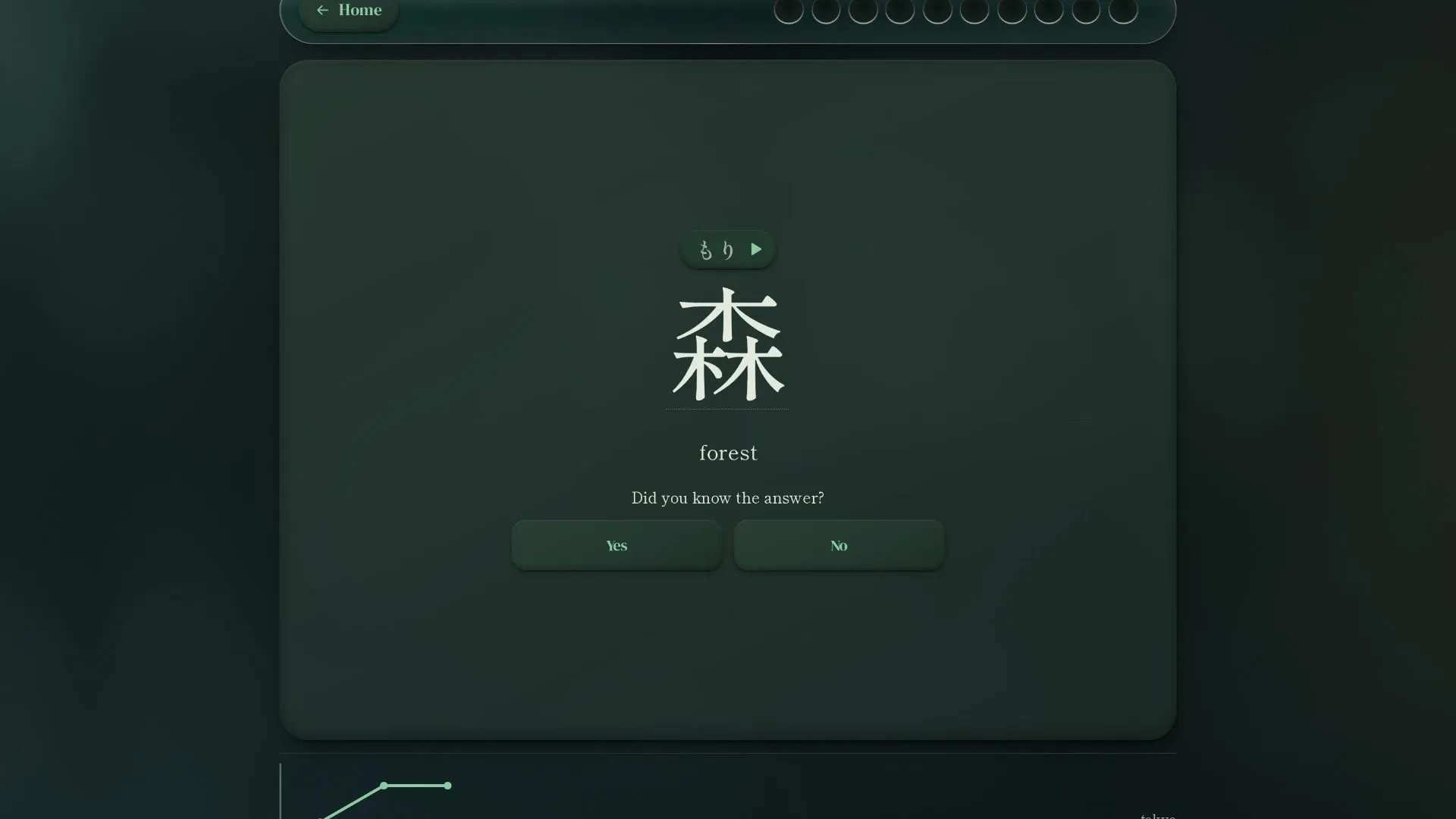
Each word or kanji is studied as separate skills: recognizing the meaning, reading it, writing it stroke by stroke, and its pitch accent. Reviews are scheduled with FSRS, a spaced-repetition algorithm that estimates when you are about to forget something and shows it to you right before.
Decks are built by JLPT level, school grade or word frequency, and by HSK 3.0 level for Chinese. All audio is pre-recorded: about 17,400 clips in Japanese and 11,000 in Chinese.
Technical decisions
- Progress per skill. Missing a kanji when writing it does not reset what you already knew about recognizing it.
- Data with verified sources. Content comes from open dictionaries (JMdict, KANJIDIC2, KanjiVG, CC-CEDICT and others), and I checked each license. When a piece of data does not exist, the app shows it as missing instead of making it up.
- Chinese as an optional layer, not a parallel course: a 日本語 | 中文 switch, its own dictionary, pinyin above the characters and audio matched by tone.
- Payments through Paddle. Stripe does not accept Peru-based merchants, so the paid plan uses Paddle as merchant of record.
- A TypeScript monorepo (React + NestJS + PostgreSQL), with about 190 unit test files and end-to-end tests in Playwright.
Status
Sign-up is closed for now: I am load-testing the server and preparing a paid plan before opening it to the public.